
How Footplate Rotation Reduces Knee and Ankle Forces
Michelle L. Lange, OTR/L, ATP/SMS
Footplate Rotation is the latest option on the Seating Dynamics Dynamic Footrest. This blog takes a closer look at what happens to the knee and ankle joints during footplate rotation including joint movement and force. While I love to dive into lower extremity anatomy and physics, which I can really ‘geek out’ over, you may be thinking to yourself, “why should I read this blog?” I’m so glad you asked! Dynamic Seating moves in response to client forces, diffusing those forces. It is critical that any movement provided through Dynamic Seating does not actually create more force in a joint.
Terminology
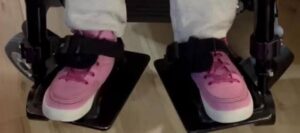
Let’s start with some basic terminology. When describing the motion of the foot when the footplate rotates outward, the foot is rotating laterally. This is sometimes referred to as external rotation. From the transverse plane (looking from above), rotation occurs around the long axis of the tibia, intersecting the midline of the foot. This should not be confused with Tibial Torsion which results in the feet remaining in lateral rotation secondary to rotation of the tibia, rather than active movement into lateral rotation.
What Muscles Rotate the Foot Laterally During Sitting?
When the foot laterally rotates while the person is in a sitting position, the lower leg also rotates outward (tibial external rotation). The muscles which cause this movement are the biceps femoris (lateral hamstring muscle) and the lateral gastrocnemius (outer head of the calf muscle). These muscles rotate the tibia (shin bone) relative to the femur (thigh bone). Other muscles involved are the plantaris and soleus. It is also important to note that tibial rotation (at the superior tibiofibular joint) occurs during knee extension and flexion, as well as during ankle plantar and dorsi flexion. Many people using the footplate rotation option will extend at the knee and ankle in combination with foot lateral rotation.
How do Foot Lateral Rotation Forces Impact the Lower Extremity?
If a person is seated in their wheelchair, extends, and cannot move their knee and ankle (such as through Dynamic Footrests), client forces will increase in the knee and ankle joints. Some of these forces are dissipated through the joint itself. For example, the superior tibiofibular joint dissipates torsional (rotational) stresses applied at the ankle joint (such as pushing against a static footplate). Pushing against that static footplate creates weightbearing which blocks rotation of the tibia and so forces must be dissipated through the fibula and that superior joint.
Body weight on the foot bones produces compression stress. This stress is highest when in line with the movement creating the load. What does that mean? Well, if the client is pushing against their footplates, the force is highest along that line of action – through the feet, ankles, knees, and hips. That force has to go somewhere. Perhaps you learned about Newton’s Third Law in a high school physics class. Every action has an equal and opposite reaction. When the client exerts force on the footplate, that force returns to the leg.
Studies have shown that people with increased muscle tone can exert tremendous force against the footplates. Samaneein (2013) found that during extension, participants exerted up to 600% of their bodyweight on the footrests. To put that in perspective, someone weighing 100 lbs. could exert up to 600 lbs. of force on the footplates. If the force is unrelieved, that force will return through the legs, typically where any movement occurs – at the joints (hips, knees, and ankles).
We can extrapolate that if the feet would laterally rotate as a part of lower extremity rotation, and if this movement was blocked, that force would return through the ankles and knees. This would result in increased force within those joints.
Conclusion
People using wheelchair seating who tend to extend through their lower extremities may exert significant forces against static wheelchair surfaces, such as a footplate. If these forces are unrelieved, force returns through the leg, particularly in the hip, knee, and ankle joints. This can lead to client pain and injury. Dynamic Footrests provide movement to diffuse force at the hips, knees, and ankles (into plantar flexion and foot rotation) to protect the client, as well as the equipment.
If these forces are unrelieved, force returns through the leg, particularly in the hip, knee, and ankle joints. This lead to client pain and injury