
Clinician Interview: Suzanne Wilhoit, OTR/L, ATP
Michelle L. Lange, OTR/L, ATP/SMS
Suzanne Wilhoit is an Occupational Therapist in East Tennessee. She started practice at the Green Valley Developmental Center – the center later closed, however the seating clinic remained – where she worked for 6 years and received her ATP certification. Suzanne then worked in a nursing home setting for several years where she continued seating and positioning, though with less complex rehab technologies. She now works about half of her time in group homes and half in an outpatient seating clinic. Suzanne loves the challenge of “can I get them what they need?”
Suzanne has worked with two clients who use Dynamic Seating for many years. She has also recommended Dynamic Seating for a number of other clients she has evaluated, though does not see on a regular basis. Suzanne first heard of Dynamic Seating through a course at the International Seating Symposium and knew she needed to try this intervention with some of the clients she worked with.
Belinda – she needs to move!
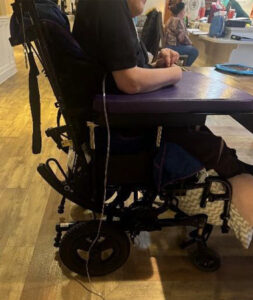 Suzanne has known Belinda for 20 years and has evaluated her wheelchair seating for the last 7 years. Belinda lives in a group home and is non-verbal. Belinda has a Quickie IRIS tilt in space manual wheelchair with a custom back and Jay 2 cushion. Without adequate support, her trunk leans to one side.
Belinda likes to rock and does so to self-soothe. If she cannot rock, she quickly becomes agitated and tends to yell and scream. Before receiving a Dynamic Back, she was rocking in her static manual wheelchair. This led to excessive wear on the wheelchair frame as well as loss of position as her pelvis slid forward on the seat. Suzanne noted metal fatigue of the back canes and mounting hardware. The most significant damage indications were on the back cane hardware, where the bolt holes had significantly enlarged allowing excessive movement and increasing the potential damage. Suzanne knew that a Dynamic Back was needed.
Problem list: equipment damage, loss of position, agitation, sensory seeking.
Since receiving a Dynamic Back, Belinda is less agitated. Suzanne believes that movement provides the proprioceptive input Belinda needs to self-soothe. Being calmer also allows her to better participate in activities. Belinda has long standing GI issues which create pain. Since receiving a Dynamic Back, she is much more comfortable as this movement appears to be helping her digestion.
Results: no further equipment damage, remains in position, calmer, increased participation, improved digestion.
Jonathan – aka, ‘Wreck-It Ralph’
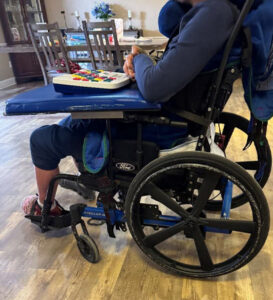 Jonathan sustained a brain injury secondary to a motor vehicle accident at age 17. He is now 39 and living in a group home. He has used a power wheelchair in the past though now primarily uses a PDG tilt in space manual wheelchair with an off-the-shelf cushion and back support. Jonathan is very hard on his equipment and has earned the nickname, “Wreck-It Ralph”. Before receiving Dynamic Seating, Jonathan had moved equipment out of alignment and broken footrests, back cane hardware, and the back canes themselves. He also slid out of position throughout the day.
Problem list: equipment damage, loss of position.
After receiving Dynamic Footrests and a Dynamic Back, Suzanne reports a 50% reduction in wear and tear on the wheelchair and seating system. Most of this additional damage occurs for reasons not addressed through Dynamic Seating, such as Jonathan grabbing onto surfaces around him and pulling until the wheelchair tips. And although Jonathan broke the lower portion of one Dynamic Footrest (non-Seating Dynamics brand), this was repaired and is now working well. He also stays in position in relation to the seating system far better than before.
Results: significant reduction in equipment damage, improved posture.
Keep up the great work, Suzanne!