
The Dynamic Rocker Back Interface and Back Support Mounting: 4 is better than 2!
Michelle L. Lange, OTR/L, ATP/SMS
The Dynamic Rocker Back interface (DRBi) is designed to move in response to client movement and force. Energy is stored to return the client to an upright posture, and the pivot point is placed so that the client does not collapse into a posterior pelvic tilt. The DRBi is attached at the base of the wheelchair back canes, allowing any type of back support to be mounted.
1, 2, or 4 points of attachment
Off-the-shelf back supports can usually be mounted with 1, 2, or 4 points of attachment.
In a single point of attachment, the back support mounts to a horizontal cross bar rather than directly to the back canes. Adjustments are typically provided by rotating the back support on this cross bar and adjusting the position of the cross bar itself. This may reduce the overall weight of the mounting hardware.
Some key advantages of 2 points of attachment are:
- easier back support placement on, and removal from, the wheelchair frame
- easy back depth and height adjustment
- the ability to set the angle of the back support in relation to the back canes.
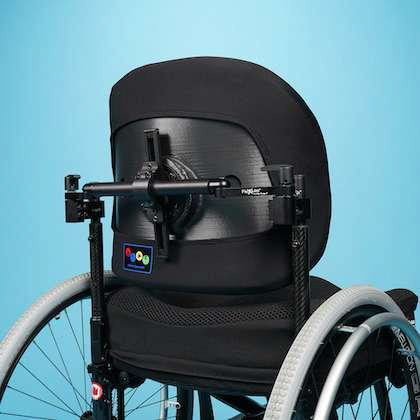
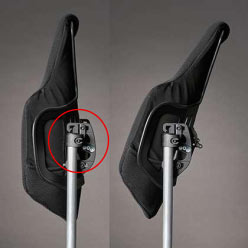
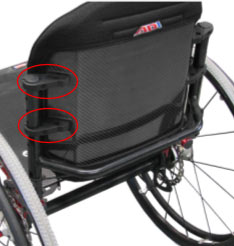
A key advantage of 4 points of attachment is ensuring that the back support does NOT change angle in relation to the back canes. The seat to back angle is changed by changing the angle of the back canes themselves.
How Does This Relate to the DRBi?
If you are working with a client who is exerting a great deal of force against the back support, the DRBi can diffuse that force, protecting both the client from injury and the equipment from damage. Often when a client extends at the hips, there is increased force in the scapular area against the upper portion of the back support. If the back support attaches at only 2 points on the back canes, the client may rotate the back support on the back canes due to these strong forces, even with the use of the DRBi. The DRBi provides a pivot point on the back canes themselves at about level with the hip joint. The back support mounting hardware, being angle adjustable and only attaching in 2 locations, provides a second pivot point – vulnerable to movement under these extreme forces.
So, if you are recommending an off-the-shelf back support for a client who is exerting significant force, consider the Dynamic Rocker Back interface to diffuse these forces. However, also consider 4 points of attachment to prevent the back support from rotating on the back canes. Together, the DRBi and a back support with 4 points of attachment can meet a client’s positioning needs while diffusing force and maintaining client posture.