
Positioning the Head: some general strategies
Michelle L. Lange, OTR/L, ATP/SMS
Many wheelchair users have decreased head control and may sit with the head in a suboptimal position. An upright and aligned head position is critical for vision, breathing and swallow. The position of the head is dependent on far more than the head support used. The position of the pelvis and trunk greatly impact head position, as does overall position in space. Numerous strategies may be employed to optimize head control and position.
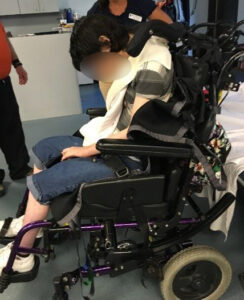
Forward head position
Why is the Client not Holding Their Head Upright?
Decreased head control is typically caused by decreased muscle tone, neck strength, motor control or paralysis. Suboptimal head positions may also be caused by:
- hyperextension of the neck in compensation for poor trunk control
- forward tonal pull
- visual impairments such as midline shifts and cortical visual impairment
- an attempt to optimize swallowing
- an attempt to optimize breathing
It is important to identify the cause of a suboptimal head position before choosing the best intervention.
General Interventions
Head position is quite dependent upon the position of the trunk and pelvis. If the pelvis is in a posterior tilt, the trunk will be flexed or kyphotic. Due to the flexion of the trunk, the neck will also be flexed and any attempt to right the head will result in neck hyperextension. If the pelvis is in an anterior tilt, the trunk will be extended or lordotic. This may lead to hyperextension of the neck as the client attempts to keep the trunk upright and the head balanced over the pelvis. In general, the pelvis should be placed in a neutral alignment, if possible, and the trunk supported in an upright posture. If the shoulders remain protracted or rounded, seating interventions to promote scapular retraction can help the client maintain a more upright and aligned head position.
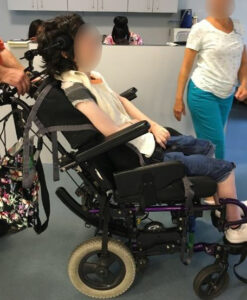
Opened seat to back angle to optimize swallow
For people with decreased head control, gravity can pull the head forward. Opening the seat to back angle or providing some posterior tilt in space can reduce the influence of gravity on head position and facilitate head control. For clients with a non-reducible kyphosis, the seat to back angle can be increased and/or tilt used until the head is over or just behind the pelvis. This will allow the client to balance their head over the kyphosis without neck hyperextension. In clients without kyphosis, a significant amount of recline or tilt will often maintain the head in contact with a head support but this is not a functional position and may even result in further loss of head control as the client does not have to activate their neck muscles as much as when in upright.
If the evaluation team suspects that vision is impacting head position, a referral can be made to a Neuro-Optometrist for evaluation and recommendations. Some interventions may improve head alignment, particularly in the case of midline shifts. For clients with Cerebral Visual Impairment (CVI), atypical head positions are to be expected, as well as allowed. The client may need to assume a specific position to optimize vision – often with the head slightly forward and/or tilted.
Once head position has been optimized through these strategies, the evaluation team can determine the most appropriate head support.
Head Supports
Quite a variety of head supports are available to meet individual need. These head supports have unique features designed to match specific requirements. Posterior head supports are by far the most common and may include lateral support. Collars provide support under the jaw and the suboccipital shelf. Forehead supports or straps provide support anterior to the forehead. One product, the Head Pod, provides support superior to the head, allowing for rotation and some limited flexion and extension while supporting/suspending the head in an upright position.
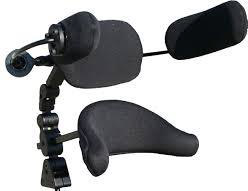
Stealth Products Ultra head support with occipital, suboccipital, and lateral supports
Head supports are commonly referred to as head rests as many clients use this seating component to rest against. A simple posterior head support provides a surface for the occipital area to rest against but offers little postural support and cannot prevent neck hyperextension unless placed at an angle to cup the suboccipital shelf. Some posterior head supports do include a generic contour designed to contact the suboccipital shelf. Other supports include a separate suboccipital pad designed to be placed inferior to this shelf to provide some actual head support and to limit neck hyperextension in combination with a separate occipital pad.
Lateral supports can be used to limit lateral neck flexion and rotation. When this position is difficult to correct, 3 point contact may be required. This requires lateral support at either side of the head, as well as lateral support along one jaw, often provided by the suboccipital pad. This force and counterforce provide neck alignment.
Materials and upholstery can be customized to meet an individual’s needs, as well. Softer materials are appropriate when the head support becomes a weight bearing surface, such as when the client spends a great deal of time tilted or reclined. Smoother upholstery can reduce friction which leads to actual hair loss on the back on the scalp for many clients using head supports.
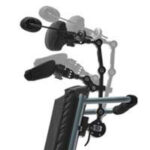
Dynamic head support hardware moves in response to client force and movement. Providing some movement can diffuse force, protecting both the client and the mounting hardware from harm. This movement may also reduce overall tone.
Collars may be explored if other options cannot maintain the head in an upright position. Support is provided to the head under the jaw and under the suboccipital shelf. Some clients may actually demonstrate an increase in head control as they are now able to move their head within a limited range of motion. Specific collars are available which can be used with clients who have a trach and/or ventilator. Certain collars cannot be safely used in transport.
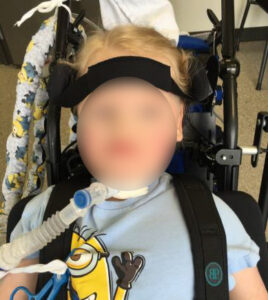
Anterior forehead support is truly a last resort option when nothing else has worked. Forehead supports include a swing-away pad(s) in front of the forehead or a strap across the forehead. Straps which move with the client’s head (typically allowing some rotation) are more likely to remain in position. Use of anterior forehead support may result in loss of residual head control as the neck muscles are not as active. These options cannot be used in transport and a soft cervical collar is recommended when in the vehicle.
Conclusion
A critical part of wheelchair seating is achieving and maintaining an upright and aligned head position. Positioning the head involves far more than choosing a head support. Using a combination of seating strategies as well as matching product features to an individual’s needs will improve the final outcome for the client.
Interested in more information? Check out our 2 hour, CEU approved on-demand course, Positioning the Head here.